
Elon Musk reportedly participated in a phone call between US President Donald Trump and Indian Prime Minister Narendra Modi to discuss the Iran crisis, raising questions about his involvement in diplomatic discussions.

Nobody takes Pakistan seriously and therefore Pakistan's sudden mediating with almost immediate results of a ceasefire seems more contrived than real, points out Vice Admiral Biswajit Dasgupta (retd).

Union Minister Kiren Rijiju criticises Congress leader Rahul Gandhi's parliamentary conduct, accusing him of being unduly influenced by advisors and questioning his casual attire in the House.

The delegations from the US and Iran head to Islamabad on Friday, carrying a ceasefire that is already fraying, a Strait that is technically open and practically closed, and a negotiating agenda that would challenge even parties actually negotiating in good faith, which these groups are not. Prem Panicker continues his must read blog on the Iran War.

President Donald Trump has withdrawn the United States from over 60 international organisations, including United Nations bodies and the India-France-led International Solar Alliance, calling the institutions 'redundant' and 'contrary' to America's interests.

The Indian government has convened an all-party meeting to discuss the ongoing crisis in West Asia, following Prime Minister Modi's address to Parliament on the situation and its potential impact on India.

An India-flagged LPG tanker, Jag Vikram, has successfully crossed the Strait of Hormuz following a temporary ceasefire between the United States and Iran, marking a significant development for India's energy security.

Iran has blamed the US for disruptions in oil and gas shipping through the Strait of Hormuz, citing 'destabilising actions' as the cause amid the ongoing West Asia conflict and rising energy prices.

'India should understand that we are not going to make the same mistakes with India that we made with China 20 years ago.'

The Congress party has criticised Prime Minister Narendra Modi's diplomatic efforts following the ceasefire agreement between the US and Iran, facilitated in part by Pakistan. The party claims this development undermines Modi's strategy and exposes his perceived failures in foreign policy.

India observed the first anniversary of the Pahalgam terror attack, with leaders paying homage to the victims and asserting the country's commitment to fighting terrorism.

Pakistan is set to host face-to-face talks between the United States and Iran, aiming to solidify a fragile ceasefire and prevent further conflict in West Asia. The discussions will focus on a long-term peace arrangement, including sanctions relief, regional security, and Iran's nuclear program.

If Trump wants peace with Iran, Pakistan will offer to help. If Trump seeks Pakistan's aid to spy on Iran, then too Munir will not hesitate to chip in. At the same time, the ISI will not hesitate to tip off Iran now and then, points out M R Narayan Swamy.
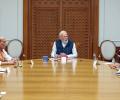
Prime Minister Narendra Modi will chair a meeting of the Cabinet Committee of Security (CCS) in Delhi to discuss the global situation following the attack on Iran and the killing of Iranian Supreme Leader Ayatollah Ali Khamenei.

US President Donald Trump's threats against Iran have drawn strong condemnation from Democrat leaders, who are calling for his removal from office, while some Republicans express concern.
India addresses the escalating conflict in West Asia, outlining its diplomatic efforts to ensure energy security, the safety of its citizens, and advocating for a peaceful resolution through dialogue.

The Indian government informed Parliament that India and the US are engaged in negotiations for a mutually beneficial multi-sectoral bilateral trade agreement. The two countries also cooperate on strategic, economic, and defense matters, managing divergences through high-level dialogues.

Egypt, Pakistan, Saudi Arabia and Turkey met in Islamabad in what analysts say is the formal opening of a new diplomatic formation that could reshape the post-war regional order. Their immediate goal is a ceasefire; their larger ambition is to ensure that neither Iran nor Israel emerges from this war in a dominant position. Pakistan's foreign minister then flew directly to Beijing and mooted a Chinese role as guarantor of any eventual agreement. Prem Panicker continues his must read daily blog on the Gulf War.

The United States, which entered this war in expectation of a short, sharp win along the Venezuela model, is now preparing for deeper involvement in a conflict it does not fully control, without the allies it typically relies on, against an adversary that is not behaving as expected, in a global environment that is already absorbing economic shock. Prem Panicker continues his must read daily blog on the Gulf War.

Chaffing under public ridicule in the US as well as internationally for having 'lost' the war, Trump is under immense pressure to do something, cautions Ambassador M K Bhadrakumar.

He added that opposition parties were assured that their concerns regarding the impact of the West Asia situation on India and the safety of Indian citizens were addressed in detail.

"The US President's statements are within the framework of efforts to reduce energy prices and gain time to implement his military plans," the ministry stated.

The cost of the war is being counted not in the corridors of power in Washington or Tehran, but in Firozabad's darkened furnace rooms, Howrah's idle casting sheds, and a barbershop in Kochi where the wait is suddenly, inexplicably, an hour long, notes Prem Panicker in his must read blog on the Iran War.

The LPG squeeze on India's restaurant sector is the quotidian face of a deeper crisis.

External Affairs Minister S Jaishankar affirms India's self-determined and 'unstoppable' rise, emphasising the nation's strategic growth and role in the Indian Ocean region amid evolving global dynamics.

Citizens and residents across the Gulf region are preparing for Eid amidst regional conflict, impacting festivities and daily life.

The Dhurandhar movies will undoubtedly shape the minds of the audience much more than news reports, court investigations, books and documentaries. But it is worth remembering that Pakistan's irridentist claims against India's national security have succeeded due to strategic planning, diplomacy, and the unsung heroines and heroes across government agencies, not due to a single maverick leader, points out Shweta Desai.But it is worth to remember that Pakistan's irredentist claims against India's national security have succeeded due to strategic planning, diplomacy, and the unsung heroines and heroes across government agencies -- not a single maverick, points out Shweta Desai.

India has firmly denied allegations that the US Navy is using its ports to launch attacks against Iran, reaffirming its commitment to strategic autonomy and non-alignment in international conflicts.

India is set to host its first-ever National Indoor Athletics Championship in Bhubaneswar, marking a significant step towards hosting the World Indoor Athletics Championships in 2028. The event will feature a 200m track and various field events, providing a novel experience for Indian athletes.

Captured in powerful images and unforgettable moments, 2025 emerged as a turning point in global affairs. These images tell the defining stories that shaped the world across continents.

India's handling of the Iran crisis reflects a growing strain between strategic autonomy and geopolitical alignment, observes Ambassador M K Bhadrakumar.

Rahul Gandhi engaged with German think-tanks and addressed the Hertie School in Berlin, discussing India's trajectory, democracy, and global cooperation. He also addressed the Indian community, emphasizing the importance of truth and democratic values.

The Enforcement Directorate has filed a chargesheet against former Reliance Communications president Punit Garg and another individual in connection with a money laundering probe linked to an alleged Rs 40,000 crore bank loan fraud.

The core issues to be settled -- access to Hormuz, Israel's aggression in Lebanon, the question of Iran's nuclear programme, sanctions relief and compensation -- are thorny enough to require weeks of patient negotiation. The most likely outcome of the opening sessions is that both sides take the measure of each other, establish what is and is not negotiable, and return home without having broken anything. That would count as progress.

The Cabinet Committee on Security (CCS) has reviewed the evolving situation in West Asia, directing departments to assist Indian nationals affected by recent developments and emphasizing the need for dialogue and diplomacy.

The US President had hosted Modi for an official working visit in Washington, DC, on February 13 last year.

This weekend, Donald Trump has begun to say the quiet part out loud -- that he wants to take control of Iran's oil, a formulation more in line with his robber-baron style of international relations.

Delhi should keep all its options open in what is essentially a transitional period in the geopolitics of energy rather than remain a gatekeeper serving Trump's 'America First', suggests Ambasssador M K Bhadrakumar.

Israel and the United States had a plan. Iran punched back. And now the Gulf is reeling, the world is beginning to feel the pain and, as on date, no one in Washington or Tel Aviv appears willing to admit that the punch has landed, notes Prem Panicker, continuing his must-read blog on the war in the Middle East.

'Was the five-day pause ever meant to hold, or was it simply another instrument of signaling, of positioning, of buying time in a war where even the pauses are tactical?' asks Prem Panicker in his must read daily blog on the Gulf War.
